
Why Do Newly Public Stocks Like SpaceX Swing So Wildly at First?
SpaceX's price is set by an estimated 3 to 5 percent tradable float. Here is why a thin float drives wild IPO swings and how to read them.
By the Deriv desk · 24 June 2026 · 4 min read

A stock's price is set only by the shares that can actually trade. When that slice is tiny, the price swings violently and tells you about scarcity, not the company.
SpaceX (SPCX) went public on June 12, 2026 at $135. Within days it spiked to an all-time high near $226, then slid back toward the mid-$150s. The business did not change that much in two weeks. The float did the talking.
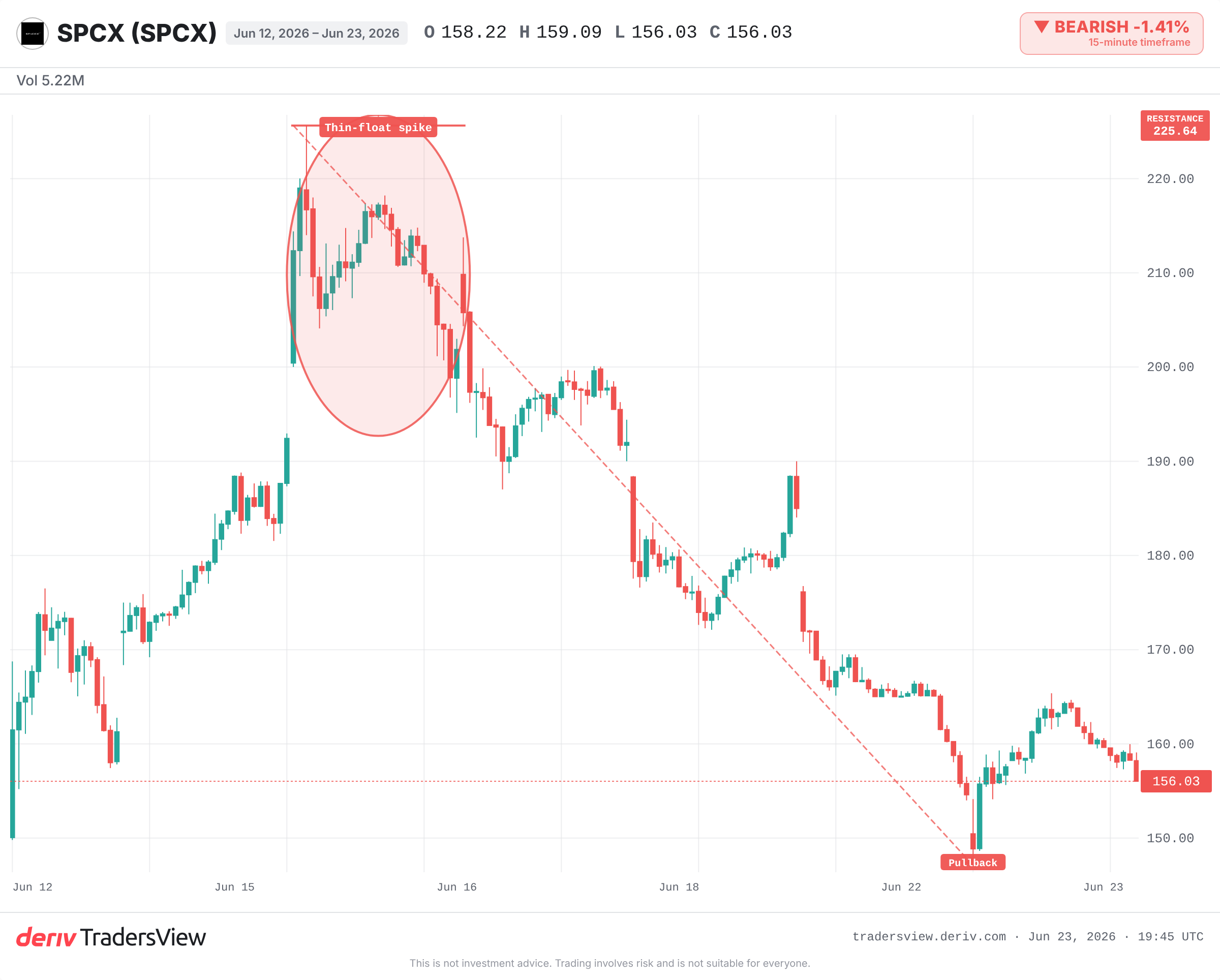
What does "thin float" mean, and why does it matter?
Float is the portion of shares that can freely trade. For SpaceX, an estimated 3 to 5 percent of shares are actually tradable. The rest is locked up with insiders and early backers.
So the price millions of people watch is being discovered by a tiny sliver of the company. A small float means a handful of buyers and sellers set the headline price for everyone. When demand outstrips that thin supply, the price gaps up fast. When the rush fades, it drops just as fast.
Why a stronger demand spike hits a small float so hard
Picture a stadium with one open exit. While everyone wants in, the doorway looks priceless. The moment the crowd turns to leave, the same narrow doorway makes the exit brutal.
That is a thin-float stock. The narrowness amplifies whatever the crowd is feeling. Scarcity exaggerates moves in both directions, up on the way in and down on the way out. A mature large-cap like Amazon trades billions of dollars of real supply daily, so single trades barely move it. A fresh IPO with a locked-up float has no such cushion.
Has this happened before?
Repeatedly. LinkedIn floated only about 8 percent of its shares in 2011 and jumped over 80 percent on day one, then stayed wild for months until more supply arrived. Saudi Aramco floated around 1.5 percent in 2019, and its thin slice propped up a headline value that drew lasting doubt.
Rivian is the cautionary one. It floated a limited slice in 2021, briefly out-valued established carmakers, then fell over 80 percent from its peak as lock-ups expired and real supply hit the market. Thin-float euphoria tends to reverse once genuine supply arrives.
How should you read SpaceX's price right now?
Carefully, and with the float in mind. The pullback toward the $150s is not automatically a verdict on the business. Scarcity can exaggerate the downside too, so part of the drop may be the same thin float working in reverse.
The valuation gap says it all. Morningstar pegs fair value near $63. The Wall Street five-analyst average sits above $235. When serious desks can disagree by that much, the float is talking louder than the fundamentals. SpaceX's launch dominance and Starlink revenue are real, but the tape is noisy by design.
The tell to watch is when more shares unlock. As lock-ups expire, supply rises and the scarcity premium can deflate quickly. If the price starts tracking company milestones rather than float-driven swings, that is the sign price discovery is maturing. Leveraged products like the 2X SpaceX ETF amplify every one of these swings, plus daily-reset decay in choppy ranges, so they magnify the noise rather than clarify it.
Frequently asked questions
A lock-up is a set window, often 90 to 180 days, when insiders and early investors are barred from selling their shares. When it expires, more shares can trade, increasing supply and often deflating a scarcity premium.
A very wide range, from Morningstar's roughly $63 fair value to a Wall Street average above $235, reflects deep uncertainty about a newly public name with a thin float. The disagreement itself signals the float is driving the tape more than agreed fundamentals.
Yes. A 2X daily ETF aims for roughly double the stock's daily move and resets daily, which causes value decay in choppy, sideways ranges. On a volatile thin-float name, that amplifies both the swings and the erosion.
Not necessarily. With a thin float, scarcity can exaggerate moves down as well as up, so a pullback may be a float artifact rather than a judgement on the business. Watch whether the price starts tracking real company milestones.